

Freight Forwarder in Pakistan: A Guide to Shipping & Costs
International shipping is no longer only reserved for multinational conglomerates; it has become important for small online sellers, local manufacturers, and individuals in Pakistan. Whether you are sending hand-stitched textiles to a boutique in London or a gift to family in Toronto,finding a reliable freight forwarder in Pakistan can provide the essentials. can provide the essentials to connect to global markets. However, the industry is often perceived as a labyrinth of hidden costs and complex jargon. One of the most significant pain points for shippers is the “Dimensional Weight” surcharge, a cost that can frequently catches people off guard because it isn’t based on how heavy a box is, but rather how much space it occupies in the aircraft.
This comprehensive guide can serves as an educational blueprint to help you navigate the nuances of freight forwarding, demystify the mathematics of air cargo pricing, and understand why choosing between service types like DDP and DDU can make or break your customer’s experience. By understanding these concepts, you can transform shipping from a stressful overhead into a streamlined competitive advantage for your global ventures.
1. Why Partner with a Freight Forwarder in Pakistan?
Freight forwarding is far more complex than a simple door-to-door delivery may have involving multi-modal transport , rigorous legal documentation, carrier negotiations, and real-time customs brokerage. A professional freight forwarder acts as a strategic architect, bridging the gap between a business in Karachi and multiple international transport services. For Karachi-based businesses, this means gaining access to a world-class infrastructure including DHL, FedEx, UPS, Aramex, and DPD Europe through a single “Third-Party Logistics” (3PL) provider.
The primary benefit of working with a logistics expert is the ability to choose from a variety of shipping models. Instead of being locked into one carrier’s rigid pricing, a forwarder can offer Duty Paid (DDP) or Non-Duty Paid (DDU) options, specialized air cargo for time-sensitive documents, and even sea-air solutions for bulk shipments. This flexibility is what can helps small businesses in Karachi to scale their operations globally without needing an in-house logistics department.
2. The Hidden Reality: Why You Are Charged for “Air” (Dimensional Weight)
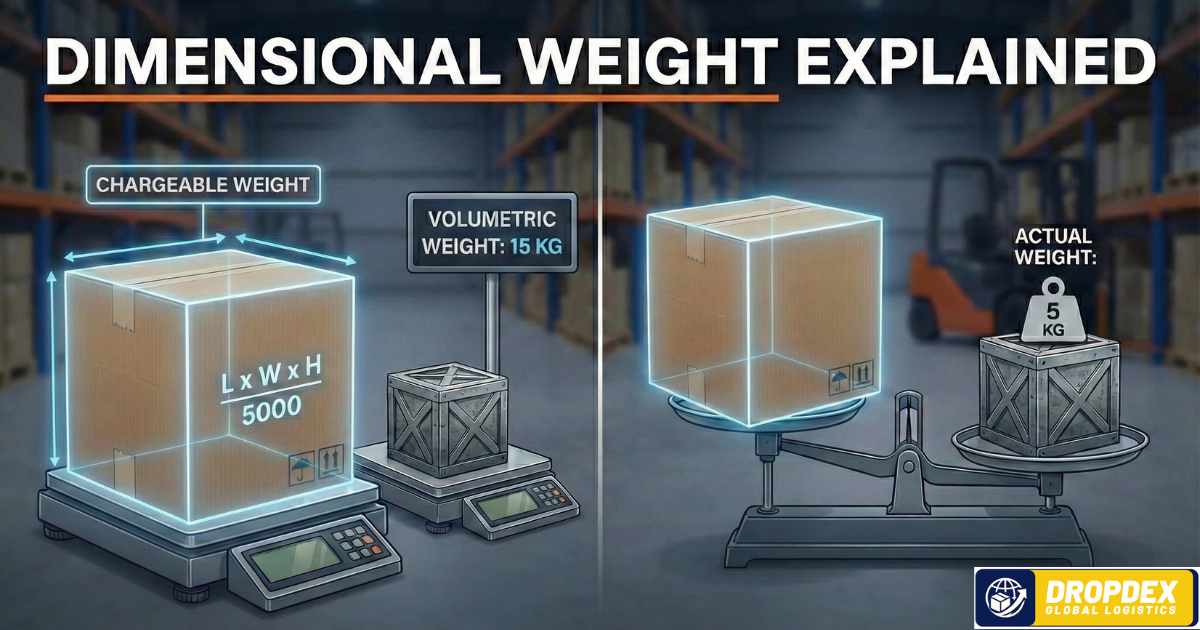
One of the most frequent complaints in the logistics is the discrepancy between the weight on a scale and the weight on the final invoice. Air cargo carriers operate on a “Chargeable Weight” model. As aircraft space is a limited and expensive resource, airlines cannot afford to fill a plane with lightweight, bulky items like pillows or empty plastic containers without charging for the volume they occupy. If a package is large but light, its dimensional weight (also known as volumetric weight) will likely exceed its actual weight, and that is the figure you may be billed for.
The Mathematics of Space
To calculate this, carriers use a standardized formula:
Chargeable Weight = (Length × Width × Height in cm) ÷ 5000 (Note: Some carriers use a factor of 6000 for economy services, but 5000 remains the global standard for air express).
For example, a box weighing 5 kg but measuring 50cm x 40cm x 30cm results in a dimensional weight of 12 kg. In this scenario, you are essentially paying for 7 kg of “air.” Understanding this formula allows shippers to pack more efficiently, use custom-fitted boxes, and eliminate unnecessary fillers, which can lead to immediate cost savings of 20% to 30% on international shipping fees.
Here is the additional, detailed section focused exclusively on Dimensional Weight strategies and cost reduction. You can append this text directly after your “Final Thoughts” section as an “Advanced Guide” or “Appendix.”
Deep Dive: Understanding Dimensional Weight to Protect Your Margins
While understanding the basic formula of dimensional weight is a good start, understanding the physics of packaging is where smart shippers truly save money. When you hand over a shipment in Karachi, digital laser scanners at sorting hubs (like those used by DHL or FedEx) measure the package’s exterior to the millimeter. If your packaging is inefficient, you are essentially paying a premium for empty space that provides no value to your customer.
Here is an advanced look at how to reduce your dimensional weight and lower your overall shipping costs:
1. The “Bulge” Factor: A Common Calculation Trap
Many shippers calculate the dimensions of an empty box (e.g., 30x30x30 cm) and assume that will be the final billing size. However, if you overstuff a cardboard box with clothes or textiles, the sides can fold outward. Automated laser scanners calculate volume based on the widest point of the package. A mere 2 cm bulge on each side can increase the chargeable volume by 15-20%.
The Fix: Use high-quality, rigid cardboard that holds its shape, or use strapping tape to compress the box and keep the sides flat. Always measure your box after it is packed and sealed, not before.
2. Poly Mailers vs. Corrugated Boxes
For non-fragile items especially textiles, garments, and fabrics common in Pakistani exports using a cardboard box is often a financial mistake. A box has a fixed volume regardless of what is inside.
The Fix: Switch to heavy-duty, tear-resistant Poly Mailers or “flyer bags.” These bags conform to the shape of the product. If you are shipping a t-shirt, a poly mailer takes up strictly the space of the shirt. This simple switch can often reduce chargeable weight by nearly 40%.
3. Box Resizing
If you must use a box, never ship one that is only 70% full. If you have 30% empty headspace, you are paying to ship that empty space to London or Toronto.
The Fix: Invest in a box resizing tool (or a simple box cutter). Slice the corners of the box down to the level of the product, fold the flaps over, and seal it at the new, lower height. This technique, often called “cutting down”, eliminates the empty space and strives you pay only for the product, not the unusable extra box space.
4. The Art of Nesting and Disassembly
For hard goods, the way items are arranged inside the box also matters.
The Fix: Use the “Nesting” technique. If you are shipping bags, place smaller bags inside larger ones. If shipping furniture or industrial parts from Karachi, disassemble any protruding parts (like legs or handles). A seemingly small protrusion can force you to use a much larger box, exponentially increasing the dimensional weight.
5. Negotiating the “Divisor”
As mentioned earlier, the standard divisor is 5000. However, this is not a law it is a negotiated contract term.
The Fix: If you are a high-volume shipper moving significant tonnage out of Pakistan, talk to your freight forwarder about your “Volumetric Divisor.” For premium accounts or specific economy routes, carriers may sometimes offer a divisor of 6000 (which is more favorable to the shipper). While rare for small accounts, it is a crucial negotiation point for growing businesses.
6. Audit Your Invoices
Finally, human and machine errors happen. Carriers process millions of parcels; sometimes a scanner malfunctions, or a package is measured while sitting on top of another object.
The Fix: Always take a photo of your package on a scale with a measuring tape visible next to the length, width, and height before it leaves your facility. If a carrier bills you for a 15kg dimensional weight when you know it was 10kg, this photo evidence can be your golden ticket to winning a dispute.
3. DDP vs. DDU: Managing International Shipping Duties
Choosing the right Incoterm (International Commercial Term) can be a critical decision for any exporter. It determines who is responsible for paying the “landing costs” the duties and taxes imposed by the destination country.
Delivered Duty Paid (DDP): The “Gold Standard” for E-commerce
In a DDP (Delivered Duty Paid) arrangement, the seller handles every single cost upfront. This includes the export fees in Pakistan, the international air freight, and most importantly, the import duties and VAT in the destination country. For a customer in the USA or UK, receiving a DDP shipment can feels exactly like receiving a domestic parcel; they don’t have to fill out paperwork or pay a penny at their doorstep. This “all-inclusive” model is essential for building brand trust, as it eliminates “delivery shock” thedissatisfaction a customer feels when a courier demands an unexpected $50 in taxes before handing over a parcel.
DDU (Delivered Duty Unpaid) / DAP (Delivered at Place)
Under DDU terms, the shipper pays only for the transport. When the parcel reaches the destination country’s customs, it is held until the receiver pays the required duties. While this makes the shipping cost look cheaper upfront, it often leads to abandoned parcels, delayed deliveries, and negative reviews. For B2B shipments where the receiver is a registered business that can reclaim VAT, DDU might be acceptable. However, for B2C (Business-to-Consumer) sales, DDP is almost usually better choice for striving a smooth, “frictionless” delivery experience.
4. 2026 Customs Updates: The Impact of IOSS and EU Reforms
As we move through 2026, international shipping is facing stricter regulatory oversight, particularly in the European Union and the UK. Historically, small parcels under €22 were exempt from VAT, but those days are gone. Now, every commercial shipment into the EU is subject to VAT regardless of value. To simplify this, the EU introduced the Import One-Stop Shop (IOSS), with sellers to collect VAT at the point of sale and speed up customs clearance.
5. The 3PL : Logistics Services in Karachi
Karachi’s status as a global logistics hub is underpinned by its Third-Party Logistics (3PL). These providers act as a “single-window” for businesses to access a many of global carriers. Instead of managing five different accounts with five different couriers, a 3PL can provides a unified platform where you can compare rates for Aramex (maybe best for Middle East), FedEx (maybe best for USA), and DPD (maybe best for Europe) in real-time.
Modern 3PL services in Karachi also offer “Route Optimization” and “Consolidation.” By grouping multiple small shipments from different Karachi sellers into one larger “Airway Bill,” these providers can secure bulk-discounted rates that would be impossible for an individual seller to get on their own. This democratization of global shipping is what helps a startup in Nazimabad or Clifton to compete on equal footing with a large manufacturer.
6. Practical Strategies to Lower Your Air Cargo Expenses
Beyond choosing the right carrier, there are several “insider” tactics you can use to reduce your landed costs:
Packaging Engineering: Switch from double-walled heavy boxes to high-strength single-walled cartons to reduce both actual and dimensional weight.
Vacuum Packing: For apparel and soft goods, vacuum sealing can reduce the volume of a parcel by up to 50%, effectively cutting your dimensional weight in half.
Pre-Verification: Always question your logistics provider for a pre-shipment weight and dimension check. This prevents the “surprise” of a re-calculated invoice after the parcel has already left Pakistan.
Duty-Paid Strategy: Incorporate the cost of DDP into your product price. While your “shipping fee” might look higher, your total conversion rate will often improve because customers value price transparency.
Final Thoughts: Shipping with Confidence and Clarity
Freight forwarding doesn’t have to be a dissatisfying expense. By understanding the concepts of dimensional weight, staying updated on DDP regulations, and leveraging the robust logistics services in Karachi, you can strive your products reach destinations like Canada, the USA, and the UAE smoothly. Smarter shipping starts with awareness; when you understand the “why” behind the costs, you can gain the knowlrdge to optimize your supply chain and grow your global footprint.